Thursday, March 3, 2011

THE GOP IS PICKING ANOTHER FIGHT WITH BIG BIRD

Big Bird is a large target for the GOP.
Rochester, N.Y.-- The budget fight in Congress is really just beginning and it's going to be a hair-raiser for independent thinkers. Republicans are claiming they'll reduce spending or shut the government down if they don't get their way. The temporary budget agreement reached Wednesday is for only two weeks, so a new shutdown threat arrives March 18.  They're willing to put even more Americans jobs on the line-- just so the GOP can score political points, hold Obama hostage and win the presidency at all costs in 2012.

What Republicans don't understand is if right-minded Americans stand together, we'll win this fight.

That's why local CSEA members are demanding a federal budget that has no cuts to vital programs, invests in jobs, and makes the rich and corporations pay their fair share.

And when we talk about vital programs, we're not just referring to Social Security, Medicare, or the many aspects of our social safety net that keep the struggling middle class and poor Americans from poverty and homelessness. We're also talking about education, the Environmental Protection Agency, and of course, NPR and PBS.

House Republicans, when deciding how they want to fund the government for the remainder of the fiscal year, immediately attacked NPR and PBS. They wanted to cut all funding -- that's right, all of it -- for the Corporation for Public Broadcasting (CPB), the nonprofit responsible for funding public media including NPR, PBS, Pacifica and more.

It would be a tremendous blow to the entire public interest media sector if they ever get their way.

Polls show voters support public broadcasting

Respondents to a national survey by a pair of bipartisan polling firms indicates 69 percent opposition to proposals to cut government funding of public broadcasting.  Read the PBS press release here.

Polls by Hart Research and American Viewpoint indicated 83 percent of Democrats, 69 percent of independents and 56 percent of Republicans oppose measures to eliminate funding.

More than two thirds of voters said Congressional budget cutters should "find other places in the budget to save money."

The poll was conducted Feb. 11-13 of a representative cross section of 804 registered voters. The survey has a 3.5 percent plus or minus margin of error.

The House approved a bill Feb. 19 that would cut all financing for the Corporation for Public Broadcasting for the year 2013.

"In an era in which reducing the budget deficit is a high priority, the public is not willing to 'cut for cutting's sake,'" said Peter D. Hart of Hart Research, a Democratic polling firm.

House Republicans disingenuously claimed that they needed to cut funding for public media because of budgetary constraints. But what they failed to highlight is that national public broadcasting is remarkably cost effective, providing local news and information, free of charge, for millions of viewers while only receiving about .0001% of the federal budget.

More to the point, it's nearly impossible to put a price tag on the actual value of public broadcasting and our local PBS affilitate, WXXI.  We cannot allow congressional Republicans to destroy public media. We fully expect Congress to fully fund NPR and defend public service media.

Public media is one of the last bastions against the corporate media, where the combination of consolidation and profit motive has long since shifted the focus to infotainment rather than substantive news. In many rural and less affluent communities, broadcasters rely on federal funding to provide the only available high-quality news and public affairs programming.

Without public media, corporate media monopolies would increase their already large control of what we see on television, hear on the radio or read in the newspaper.

The increased accumulation and consolidation of corporate power is a threat to our democracy. And nowhere is this more evident than in our media. It's important that we stand up to stop this today. America simply cannot afford to lose what public media brings to the table.

Conservatives have longed for any opportunity to defund NPR, PBS and other public media, and now it looks like they may finally get their wish -- unless we stop them.  Can you rise to the challenge?

Wednesday, March 2, 2011

"WE ARE ONE" ROCHESTER RALLY DRAWS HUNDREDS OF SUPPORTERS; SOLIDARITY AND WORKER RIGHTS FRONT AND CENTER


CSEA joined several other labor groups and their supporters at a late
afternoon rally on the steps of Rochester City Hall. Organizers estimate
that nearly 450 people attended while enduring one-degree wind chill temperatures.
(Photo: Ove Overmyer)
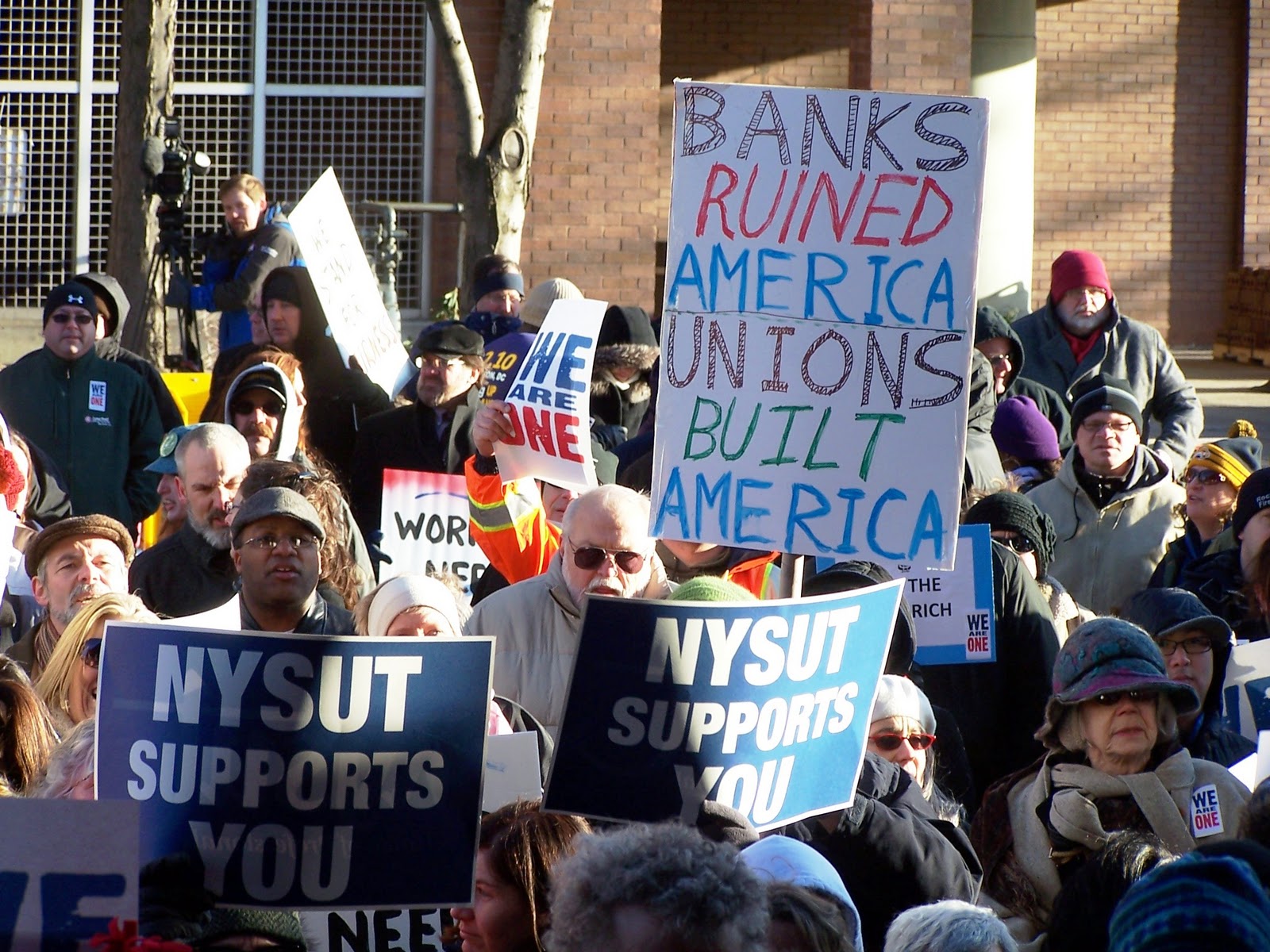
  Rochester, N.Y.-- Hundreds of members of the area’s largest labor unions and their community supporters braved wickedly cold temperatures on March 2 to gather in front of Rochester City Hall to support union workers in Wisconsin and other states. The message was a simple one: Workers deserve the right to collectively bargain and the local labor community stands tall with the Wisconsin and Ohio workers.

For nearly two hours, approximately 450 people withstood one-degree wind chills on Church Street in downtown Rochester in a show of union solidarity.

The Raging Grannies, a well-known local vocal performance group, warmed up the crowd by singing "Solidarity Forever" as the leaders of the local labor movement congregated behind them on the steps of City Hall. A total of eight speakers rallied the crowd, all who at one time or another repeatedly shouted: “We are one! We are one! We are one!”

Jim Bertolone addresses the "We Are One" rally protestors
on the steps of City Hall in Rochester, N.Y. on March 2.
(photo:  Ove Overmyer)
First to speak was Jim Bertolone, president of the Rochester & Genesee Valley Area Labor Federation, AFL-CIO.  He shouted into the public address system, “All right, brothers and sisters, are we one with Wisconsin? Are we one?  I know that this is not what Wisconsin voted for.”  The crowd spontaneously erupted in cheers and applause.

Courtney Brunelle, CSEA WNY Region 6 Political Action Coordinator, who comes from a large family of working-class teachers, spoke last and rallied the chilly crowd into a chanting frenzy.

Brunelle said, "The cuts that Governor Cuomo is proposing would devastate our communities and the most vulnerable New Yorkers. The mentally ill, senior citizens, the poor and the worst of all-- our children would suffer the most."

Brunelle also thanked Republican Governor Walker, saying he is mostly responsible for waking a sleeping giant. She said, "When the Wisconsin governor began to try to take away nearly all collective bargaining rights from state workers, he may have unintentionally given the American labor movement the lift it needed after all these years."

"We gather today to remind our community and anyone who will listen that our democracy cannot function without workers and management being allowed to engage in dialogue," said Bess Watts, Local 828 president. She told the Voice Reporter, "Collective bargaining is the heart and soul of worker rights."


Organizers estimate that nearly 450 people attended a rally in
Rochester, New York to support collective bargaining rights and
the Wisconsin Workers.
(photo:  Ove Overmyer)
Wisconsin workers are still fighting proposed deep cuts to collective bargaining rights for nearly all of the state’s public workers, posed by legislation supported by Wisconsin Governor Scott Walker.

Union leaders in Indiana and Ohio are organizing to fight similar anti-union proposals there.

In a NYT/CBS poll that was released March 1, a majority of Americans say they oppose efforts to weaken the collective bargaining rights of public employee unions and are also against cutting the pay or benefits of public workers to reduce state budget deficits.

CSEA was joined by AFSCME, the Federation of Social Workers, Public Employees Federation, Teamsters Local 118, New York State United Teachers, BENTE, Communication Workers of America, International Union of Painters and Allied Trades, United Auto Workers, Rochester Teachers Association, United Steelworkers, Service Employees International Union and other workers representing Rochester’s firefighters and police unions.


CSEA:  We stand in solidarity with the Wisconsin workers.
(photo:  Ove Overmyer)


NYT/CBS POLL REVEALS WHAT WE KNEW ALL ALONG; MOST AMERICANS SUPPORT LABOR UNIONS


NYT/CBS poll says public
employees have support of
the nation when it comes to
collective bargaining rights.
   Rochester, N.Y.-- As labor battles erupt in state capitals around the nation, a majority of Americans say they oppose efforts to weaken the collective bargaining rights of public employee unions and are also against cutting the pay or benefits of public workers to reduce state budget deficits, according to the latest New York Times/CBS News poll. This comes at a time when the Rochester progressive community is speaking out in solidarity for the workers of Wisconsin in a rally scheduled for today at City Hall.

It seems that the topic of labor unions are not exactly household conversations anymore.  A third of those surveyed viewed them favorably, a quarter viewed them unfavorably, and the rest said they were either undecided or had not heard enough about them. But the nationwide poll found that embattled public employee unions have the support of most Americans — and most independents — as they fight the efforts of newly elected Republican governors in Wisconsin and Ohio to weaken their bargaining powers, and the attempts of governors from both parties to cut their pay or benefits.

The nationwide telephone poll was conducted Feb. 24-27 with 984 adults and has a margin of sampling error of plus or minus three percentage points for all adults. Of those surveyed, 20 percent said there was a union member in their household, and 25 percent said there was a public employee in their household.

Collective Bargaining:  Proponents argue that it must happen for democractic workplaces to exist; CB affords workers due process and creates a counterbalence to absolute power

Americans oppose weakening the bargaining rights of public employee unions by a margin of nearly two to one: 60 percent to 33 percent. While a slim majority of Republicans favored taking away some bargaining rights, they were outnumbered by large majorities of Democrats and independents who said they opposed weakening them.

Those surveyed said they opposed, 56 percent to 37 percent, cutting the pay or benefits of public employees to reduce deficits, breaking down along similar party lines. A majority of respondents who have no union members living in their households opposed both cuts in pay or benefits and taking away the collective bargaining rights of public employees.

Governors in both parties have been making the case that public workers are either overpaid or have overly generous health and pension benefits. But 61 percent of those polled — including just over half of Republicans — said they thought the salaries and benefits of most public employees were either “about right” or “too low” for the work they do.

When it came to one of the most debated, and expensive, benefits that many government workers enjoy but private sector workers do not — the ability to retire early, and begin collecting pension checks — Americans were closely divided. Forty-nine percent said police officers and firefighters should be able to retire and begin receiving pension checks even if they are in their 40s or 50s; 44 percent said they should have to be older. There was a similar divide on whether teachers should be able to retire and draw pensions before they are 65.

NYT/CBS poll says state governments should
tax the rich before cutting workers wages and benefits.
(photo:  Ove Overmyer)
Tax the rich, not the working class

Tax increases were not as unpopular among those surveyed as they are among many governors, who have vowed to avoid them. Asked how they would choose to reduce their state’s deficits, those polled preferred tax increases over benefit cuts for state workers by nearly two to one. Given a list of options to reduce the deficit, 40 percent said they would increase taxes, 22 percent chose decreasing the benefits of public employees, 20 percent said they would cut financing for roads and 3 percent said they would cut financing for education.

The most contentious issue to emerge in the recent labor battles has been the question of collective bargaining rights. A proposal by Gov. Scott Walker of Wisconsin to weaken them sent Democratic state lawmakers out of state to prevent a vote, flooded the Capitol in Madison with thousands of protesters and sparked a national discussion about unions.

The poll found that an overwhelming 71 percent of Democrats opposed weakening collective bargaining rights. But there was also strong opposition from independents: 62 percent of them said they opposed taking bargaining rights away from public employee unions.

The one group that favors weakening those rights, by a slim majority, was Republicans.

Although cutting the pay or benefits of public workers was opposed by people in all income groups, it had the most support from people earning over $100,000 a year. In that income group, 45 percent said they favored cutting pay or benefits, while 49 percent opposed it. In every other income group, a majority opposed cutting pay or benefits: Among those making between $15,000 and $30,000, for instance, 35 percent said they favored cutting pay or benefits, while 60 percent opposed it.

Public perception is sometimes skewed; does not always reflect reality

BIG LABOR?  So much for the coded, overused label spewed by big business and conservative media types.  America's labor unions, including private sector labor unions, are seen as less influential now than they were three decades ago. The poll found that 37 percent of those surveyed believe that labor unions have “too much influence” on American life and politics, while 48 percent said they had the “right amount” or “too little” influence. In a 1981 poll, by contrast — soon after President Ronald Reagan fired striking air traffic controllers — 60 percent of those surveyed said unions had “too much influence.” Of course, union membership has declined since then.

RALLY TODAY AT CITY HALL; HUNDREDS EXPECTED AT CHURCH AND FITZHUGH

The progressive community is coming together to join in defense of Collective Bargaining and workplace rights

Rochester, NY-- After 100,000 people filled the capitol in Madison, Wisconsin last weekend, and while events took place in ALL 50 state capitals, momentum continues to build in support of our working families.

Please join our solidarity event today.  Hundreds of demonstrators are expected to gather in front of Rochester City Hall, on Wednesday, March 2, 2011 beginning at 4:30 p.m. Demonstrators will voice their support for embattled workers in Wisconsin, Indiana, Ohio and elsewhere.

“This is about one thing: our right to discuss working conditions with management,” stated Jim Bertolone, President, Rochester & Genesee Valley Area Labor Federation, AFL-CIO. “Whether you call it collective bargaining, negotiations, discussions, talks or summits, this is about the fundamental principle of talking to resolve our differences. Respectful, dignified communication is the most basic tenet of a successful democracy.

Wisconsin Governor
Scott Walker
Governor Walker of Wisconsin has chosen to act unilaterally, without following the basic tenets of talking with his state’s workforce. Now, he and others around the country, seek to remove basic protections to prevent discussions, to prevent the basic respect of management talking with their employees. We will gather peacefully on Wednesday to remind our community, and others, that our democracy cannot function without workers and management engaging in dialogue.

When: Today, Wednesday, March 2, 2011, 4:30 pm

What: Rally to Support Wisconsin Working Families and in Defense of Collective Bargaining

Where: Rochester City Hall, 30 Church Street, Rochester, NY

The Rochester & Genesee Valley Area Labor Federation, AFL-CIO represents more than 300 local unions, throughout 11 mid-western New York State counties, giving voice to more than 80,000 working men and women.

The struggle for worker rights continues around the country-- the crowds continue to swell each and every day.  The people of the Badger State are very resilient folk.  For god sakes, they fish through ice!  They aren't going anywhere until the anti-labor forces loosen their grip. 
 
This action today is the least we can do to support the working families of Wisconsin.  In addition to Rochester's rally on Wednesday, other AFL-CIO and community organizations throughout New York have continued the call-to-action in support of Wisconsin's workers.  The message is, WE ARE ONE with the workers of Wisconsin! 

THOUSANDS OF AFSCME AND CSEA ACTIVISTS CONVERGE ON OUR STATE CAPITAL


photo:  Ove Overmyer

 Albany, N.Y.-- Hundreds of CSEA activists participated in AFSCME Lobby Day on Tuesday, March 1 at the state Capitol in Albany, where they met with their state senators and Assemblymembers and urged the lawmakers to oppose the governor's proposed state budget cuts and oppose cutting income taxes on wealthy New Yorkers.

Organizers estimate that well over, 2,100 union activists converged on Albany yesterday.  Click here for a YNN news broadcast of yesterday's event.

The event drew a crowd level that many longtime inhabitants said was unprecedented. As well as AFSCME and CSEA members, groups thronging the Capitol complex included statewide contingents of library supporters, tourism professionals and advocates from the New York State Lesbian, Gay, Bisexual and Transgender Health and Human Services Network.

CSEA President Danny Donohue, state Comptroller Tom DiNapoli, Assembly Speaker Sheldon Silver and Republican Deputy Senate Majority Leader Tom Libous were among the featured speakers at the program before the meetings.

By lunchtime, the line waiting to pass the security gates at the north end of the Empire State Plaza concourse stretched to the underground entrance to The Egg. And, up on the street level, there was more action in West Capitol Park. Groups under the umbrella name of GrowingTogetherNY coalition -- a progressive response to the pro-business Committee to Save New York -- attracted roughly 300 people calling on Gov. Andrew Cuomo to reduce cuts to education, libraries and other programs.

Bess Watts, CSEA Monroe County Local 828 president said she wasn't very happy about the wait in line at the security check points and the lack of attention in welcoming us at our very own statehouse. She lamented that her group was late for their appointment with Senator Maziarz. She said, "The number of people at the capitol today is riduculous-- the facility and the number of security police can not handle all the people here. Mr. Cuomo said in his inaugaural speech that he wanted to open up government, and then he laid off tour guides and secuity personnel at the Empire State Plaza and created an access problem. So much for vision."

The takeaway from Lobby Day is always a discussion for debate.  It is important to realize that a good showing of union support at these events is necessary and very demanding. However, by not showing up, you could give state legislators and your detractors the ammunition they need not to fund or support your cause when push comes to shove.  Establishing a one-on-one relationship with your representative is essential for union advocates.  Watts and the other CSEA members who attended yesterday's trip all said the same thing.  The lobbying experince is,  "One of the those things we must do to keep our lawmakers accountable."
Some of the CSEA WNY Region 6 contingent at AFSCME
Lobby Day in Albany, N.Y. on March 1, 2011.
(photo:  Bess Watts)